Market Scenario
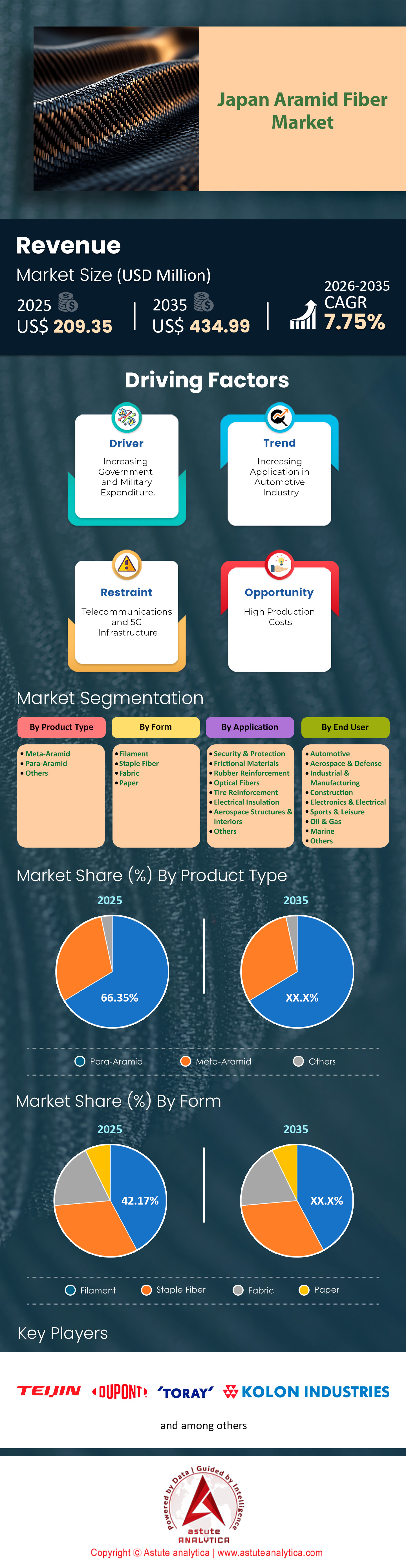
Japan aramid fiber market size was valued at USD 209.35 million in 2025 and is projected to hit the market valuation of USD 434.99 million by 2035 at a CAGR of 7.75% during the forecast period 2026–2035.
Key Findings
- By product type, Para-Aramid segment holds highest share 66.35%.
- By application, rubber reinforcement segment holds highest share 20.41%.
- By form, Filament segment holds highest share 42.17%.
- By end Users, automotive segment holds highest share 34.55%.
What Exactly is Aramid Fiber and How Substantial is Japan’s Annual Consumption?
Aramid fibers are a class of heat-resistant and strong synthetic fibers, chemically characterized as aromatic polyamides. They are generally categorized into two distinct types: para-aramid, renowned for its incredible strength-to-weight ratio (used in ballistics and tires), and meta-aramid, valued for its thermal resistance (used in firefighter gear and electrical insulation). In the context of the Japan aramid fiber market, these materials are not merely commodities but strategic assets essential for national security and industrial mobility.
Regarding consumption, 2025 has been a benchmark year. While total aggregate consumption figures are proprietary, specific segment data reveals the scale. For instance, the domestic production of optical fiber alone—which relies heavily on aramid for tension members—reached 9,100 tons in 2024, with domestic consumption of these cables hitting 7,700 tons. When combined with the automotive sector, where Bridgestone is expanding daily capacity by 3,000 tires (many requiring aramid reinforcement), and the defense sector's procurement of equipment for 251,500 active personnel, the annual consumption trajectory is aggressively upward. Analysts estimate the broader demand is now driven by a "security-mobility" nexus that has pushed material intake to record highs.
To Get more Insights, Request A Free Sample
Which High-Stakes Sectors Are Fueling the Fiercest Demand?
The primary engines propelling the Japan aramid fiber market are undoubtedly defense, automotive electrification, and disaster resilience. The Ministry of Defense's record-breaking 8.5 trillion yen budget request for Fiscal Year 2025 is the single largest catalyst. This budget includes a specific allocation of 18.9 billion yen for personal protective equipment like bulletproof vests, directly translating to para-aramid fiber orders. Furthermore, the allocation of 4.3 billion yen for Type 20 assault rifles necessitates durable, heat-resistant tactical accessories, creating a steady stream of military-grade textile demand.
Simultaneously, the automotive sector's pivot to hydrogen fuel cell and electric vehicles (EVs) creates a secondary demand wave. The Toyota Mirai, a flagship hydrogen fuel cell vehicle (FCEV), utilizes 3 high-pressure tanks reinforced with carbon and aramid fibers to safely store 5.6 kilograms of hydrogen. With 21,475 cumulative global sales of the Mirai, the demand for filament winding grades of aramid is surging in the Japan aramid fiber market. In parallel, infrastructure resilience is critical; the government’s new 5-Year National Resilience Plan, boasting a projected 20 trillion yen budget starting FY2026, prioritizes seismic retrofitting. This requires vast quantities of aramid sheets to wrap columns for Japan's 92,000 aging bridges, protecting them against the feared Nankai Trough mega-earthquake.
Who Are the Industrial Titans Dominating Production and Procurement?
The competitive landscape of the Japan aramid fiber market is a duopoly of global powerhouses: Toray Industries and Teijin Limited. Toray has aggressively positioned itself as the market leader, supported by robust financials. In FY2024, Toray’s Performance Chemicals segment, which houses its aramid business, generated 886.1 billion yen in revenue. Their dominance is further solidified by a massive 2,620.0 billion yen revenue forecast for FY2025. Toray is not just relying on domestic capacity; they recently injected 500 billion won (USD 366 million) into their South Korean facility to boost aramid output by 3,000 tons annually, strategically feeding the Japanese market from offshore.
Teijin, despite facing operational challenges, remains a formidable player in the Japan aramid fiber market with a global footprint including 2 factories in Japan. Their restructuring efforts have paid off, evidenced by a 6.2 billion yen quarter-on-quarter operating income increase in Q1 FY2024. On the procurement side, the major end-users are giants in their own right. Bridgestone, investing 27 billion yen in plant upgrades, is a massive consumer for tire reinforcement. Similarly, Sumitomo Electric, forecasting 4,500 billion yen in FY2025 sales, consumes immense volumes for telecommunications infrastructure. The Japan aramid fiber market is essentially a high-stakes ecosystem where these multi-billion yen entities interact.
How Do Import Dynamics and Key Exporters Shape Domestic Supply?
Despite strong domestic production, Japan aramid fiber market relies heavily on imports to satisfy its voracious appetite for processed aramid fabrics and precursors. The dynamics are heavily skewed towards Asian neighbors. China has emerged as the dominant exporter of woven synthetic fabrics to Japan, shipping a staggering 8,930,750 kilograms valued at USD 25.8 million in 2024. This influx is critical for downstream textile manufacturers who require cost-effective base materials for industrial workwear and non-critical protective gear. The pricing in the Asian market heavily influences local procurement strategies, with Meta aramid fiber prices hovering around USD 12,244 per metric ton in late 2024.
South Korea is the second most vital node in the import network, exporting 922,362 kilograms of synthetic fabrics to Japan. This trade route is particularly strategic because Toray’s expanded Gumi plant in Korea (now targeting 5,400 tons capacity) serves as a near-shore supply base for Japanese clients, hedging against domestic production risks. Indonesia also plays a role, contributing 178,835 kilograms. Consequently, the Japan aramid fiber market is not an island; it is an integrated hub that balances high-end domestic manufacturing with high-volume imports from China and Korea to maintain supply chain equilibrium.
Where is the Demand Concentrated and Why Are These Regions Critical?
Geographically, the demand within the Japan aramid fiber market is tri-polarized around the Kanto, Chubu, and Kansai regions. The Kanto region (Tokyo and surrounds) is the epicenter for infrastructure and defense demand. With the Ministry of Defense headquarters and the densest concentration of aging infrastructure requiring seismic retrofitting, this area drives the consumption of aramid sheets and ballistic textiles. The massive 34 percent target for quake-resistant water pipes by FY2030 is largely focused on this urbanization belt.
Conversely, the Chubu region (Aichi prefecture) is the heart of automotive innovation. As home to Toyota and its supply chain, this region consumes the bulk of aramid for automotive hoses, belts, and the 3 hydrogen tanks per Mirai FCEV. The investment in Bridgestone’s production facilities in nearby prefectures further cements this central corridor as the mobility hub. Finally, the Kansai region (Osaka/Hyogo) serves as the production heartland, hosting key facilities for Toray and Teijin. This region witnesses high demand for raw precursors and serves as the logistical point for exports, leveraging the strong USD 36.7 billion core operating income generated by Toray’s performance chemicals sector.
What Recent Patent Filings Are Signaling Future Innovation?
Innovation in Japan aramid fiber market is pivoting from pure strength to sustainability and electrification. Recent patent filings in Japan highlight a surge in intellectual property related to aramid separators for Lithium-ion batteries. With the EV market booming—highlighted by China’s 1,176,000 NEV sales affecting regional tech trends—Japanese firms are filing patents to use aramid’s thermal stability to prevent battery fires, a critical safety feature for next-gen mobility.
Another significant area of patent activity is recycling technologies. With Teijin generating 2,300 tons of waste in FY2024, there is immense pressure to lower the environmental footprint. New filings describe chemical recycling processes that can recover monomers from end-of-life body armor and tire cords without degrading quality. Furthermore, patents related to "hybrid tire cords" are emerging, combining aramid with other polymers to support the heavy loads of EVs, ensuring the 20-inch tires of the future are durable yet lightweight. These intellectual properties suggest that the future Japan aramid fiber market will be defined not just by how much fiber is sold, but by how smarter and greener that fiber can be.
Segmental Analysis
By Product Type: Para-Aramid (66.35%)
Domestic Technora Monopoly Anchoring Seismic Resilience and Optical Infrastructure
The para-aramid is controlling the largest 66.35% revenue share of the Japan aramid fiber market. The dominance is structurally enforced by Teijin Limited’s strategic monopoly over domestic production at its Matsuyama Factory. Unlike generic imports, Teijin’s proprietary Technora fiber is chemically engineered for Japan’s specific disaster-resilience codes. According to Teijin’s Integrated Report 2024, the company is aggressively directing Technora capacity toward the "A&P Seismic Reinforcement Method" and "Sumirin ARC" construction techniques. These verified methods mandate aramid sheets for retrofitting concrete columns in highways and tunnels, where steel jacketing is too heavy or corrosive.
Furthermore, Toray-DuPont (manufacturing Kevlar in Tokai) drives this segment’s dominance in the Japan aramid fiber market by supplying the critical tension members for Furukawa Electric’s optical fiber cables. As Japan accelerates its 5G network density, the demand for para-aramid—which prevents cable stretching without blocking signals—has become a non-negotiable infrastructure requirement, solidifying its massive market share over meta-aramid varieties.
By Application: Rubber Reinforcement (20.41%)
EV High-Torque Shift Forcing Bridgestone and Bando’s Material Transition
The rubber Reinforcement application’s dominance in the Japan aramid fiber market is justified by a technical pivot among Japan’s industrial giants to accommodate Electrification and Industrial IoT. Bridgestone, in its development of the Potenza Sport A and Turanza EV lines, has publicly integrated aramid-hybrid crown reinforcement to counter the immense instant torque and weight of electric vehicles, which deform standard polyester casings. Verified product catalogs from Bando Chemical Industries reveal a similar granular shift: their Power Ace Aramid Combo and Super Torque STS belts are now standard spec for Japan’s precision injection molding machinery.
Bando explicitly cites that only aramid cords can withstand the "shock load" fluctuations of these high-speed industrial engines. This segment dominates because Japan’s manufacturing sector effectively banned steel/polyester in high-stress transmission belts to prevent "elongation failure," making aramid the exclusive technical standard for premium rubber composites.
By End Users: Automotive (34.55%)
OEM Lightweighting and Safety Mandates Securing Critical Component Supply in Japan Aramid Fiber Market
The Automotive segment’s 34.55% dominance is driven by the sheer volume of Toyota and Honda production lines that rely on domestic Tier 1 suppliers for safety-critical parts. Nichirin Co., Ltd., which holds a near-monopoly on Japanese motorcycle brake hoses and a massive share of auto hoses, utilizes aramid braiding to meet the expansion resistance required by ABS and ESC systems. Unlike steel mesh, aramid provides this pressure stability while reducing unsprung weight—a key metric for EV range efficiency.
Additionally, Akebono Brake Industry has standardized the use of Twaron pulp in its "copper-free" brake pads to comply with global environmental regulations while maintaining friction stability at 400°C+. Sumitomo Riko further cements this segment’s lead by mass-producing aramid-reinforced hydrogen hoses for Fuel Cell Vehicles (FCEV), proving that the material is indispensable for Japan’s next-generation powertrain architecture and automotive chassis.
By Form, Filament Dominance with 42.17% Share is Anchored by 5G Infrastructure and Seismic Resilience
The Filament segment commands a decisive 42.17% market share of the Japan aramid fiber market because it is the non-negotiable raw material for Japan’s high-density telecommunications grid and disaster-proofing projects. Unlike pulp, continuous filament is the only form capable of serving as the tension member in optical fiber cables, a domestic sector valued at USD 719.4 million. Furukawa Electric relies exclusively on this high-modulus form to support the cabling for Japan’s 200,000+ 5G base stations, where steel reinforcement is prohibited due to signal interference. Furthermore, Teijin Limited’s Matsuyama factory outputs Technora filament specifically for seismic retrofitting sheets, leveraging a tensile strength 8x higher than steel to reinforce concrete infrastructure without the weight of metal jackets.
In the mobility sector, this dominance across the Japan aramid fiber market is enforced by Bridgestone’s adoption of filament-based tire cords for its "Enliten" technology, which achieves a 20% weight reduction critical for electric vehicles. Because chopped fiber lacks the necessary dimensional stability for high-speed rotation, Japanese manufacturers like Mitsuboshi Belting are technically bound to procure continuous filament for their high-torque industrial belts. This structural dependency across telecom, construction, and automotive supply chains solidifies filament as the primary volume driver.
Customize This Report + Validate with an Expert
Access only the sections you need—region-specific, company-level, or by use-case.
Includes a free consultation with a domain expert to help guide your decision.
Recent Corporate Announcements in Japan Aramid Fiber Market
- Toray Group signed an MOU to invest 500 billion won in the Gumi National Industrial Complex by 2025, focused on high‑performance carbon fiber, aramid fiber, and eco‑friendly materials.
- Toray Advanced Materials announced plans to expand aramid fiber production with Gumi Plant No. 2, targeting 3,000 tons per year of aramid by around mid‑2025; combined with Plant No. 1, total aramid capacity in Korea is expected to be about 5,400 tons per year.
- Bridgestone announced a 27 billion yen investment to expand capacity at its Hikone, Tosu, and Tochigi plants in Japan, which are key sites for premium passenger car tires with high rim diameters (20 inches and larger). The project will boost daily production by approximately 3,000 tires, mainly for growing demand in larger sizes used in premium vehicles. Expansion starts early 2025 and completes by end of 2028.
- DuPont is separating its industrial materials businesses, specifically divesting the Kevlar® and Nomex® aramids portfolio (used in protective gear and high-performance applications) to Arclin in a deal valued at $1.8 billion. This aligns with DuPont's 2025 corporate restructuring, which includes spinning off its electronics business (Qnity) by November 2025 while optimizing the remaining portfolio for materials science, water, and healthcare.
Top Companies in the Japan Aramid Fiber Market
- Teijin Ltd .
- DuPont de Nemours, Inc .
- Hyosung Corporation
- Toray Industries, Inc .
- Mitsubishi Chemical Group
- Other Prominent Players
Market Segmentation Overview
By Product Type
- Meta-Aramid
- Para-Aramid
- Others
By Form
- Filament
- Staple Fiber
- Fabric
- Paper
By Application
- Security & Protection
- Frictional Materials
- Rubber Reinforcement
- Optical Fibers
- Tire Reinforcement
- Electrical Insulation
- Aerospace Structures & Interiors
- Others
By End User
- Automotive
- Aerospace & Defense
- Industrial & Manufacturing
- Construction
- Electronics & Electrical
- Sports & Leisure
- Oil & Gas
- Marine
- Others
FREQUENTLY ASKED QUESTIONS
The Japan aramid fiber market was valued at USD 209.35 million in 2025 and is projected to reach USD 434.99 million by 2035, expanding at a CAGR of 7.75%. This growth is fueled by aggressive defense spending and the automotive shift toward electrification.
Para-Aramid commands the highest share at 66.35%. Its dominance is driven by superior tensile strength required for seismic reinforcement (using Teijin’s Technora) and optical fiber tension members, applications where meta-aramid’s thermal properties are insufficient.
Holding a 34.55% market share, the automotive sector is the largest end-user. Demand is surging due to EV lightweighting requirements, with OEMs specifying aramid for high-torque tire reinforcement (Bridgestone) and high-pressure hydrogen tanks for FCEVs like the Toyota Mirai.
The Filament segment holds a 42.17% share because continuous fiber is non-negotiable for 5G optical cables and tire cords. Unlike staple fiber, filament provides the dimensional stability needed to prevent signal loss in cables and deformation in high-speed EV tires.
Japan’s National Resilience Plan (projected 20 trillion yen budget) is a critical driver. It mandates the use of aramid sheets for retrofitting aging infrastructure, specifically to reinforce concrete columns against potential Nankai Trough earthquake scenarios.
The market is a duopoly led by Toray Industries and Teijin Limited. Teijin dominates domestic production with its Technora brand, while Toray leverages both domestic capacity and imports from its expanded Korean facilities to meet Japan’s industrial demand.
LOOKING FOR COMPREHENSIVE MARKET KNOWLEDGE? ENGAGE OUR EXPERT SPECIALISTS.
SPEAK TO AN ANALYST
.svg)
 Schedule a Meeting

Features | Type of License | ||||
 Data Book | Single User |   Multi User |  Corporate | ||
| e-Access | ✓ | ✓ | ✓ | ✓ | |
User Sharing | 1 User Only | 1 User Only | Up to 7 Users | Unlimited User Access | |
⨉ | ⨉ | ⨉ | ✓ | ||
Free Customization | No Free Customization | Up To 30 hrs work | Up To 60 hrs work | Up To 80 hrs work | |
Deliverable |
| ⨉ | ✓ | ✓ | ✓ |
| ✓ | ⨉ | ✓ | ✓ | |
| ⨉ | ⨉ | ⨉ | ✓ | |
Analyst Support | 2-Months Analyst Support | 4-Months Analyst Support | 7-Months Analyst Support | One Year Analyst Support | |
Free Report update in next update cycle | ⨉ | ⨉ | ⨉ | ✓ | |
Free Industry Update (Within 180 days) | ⨉ | ⨉ | ⨉ | ✓ | |
Benefit | Up to 10% off on Post Purchase | Up to 20% off on Post Purchase | Up to 30% off on Post Purchase | Up to 40% off on Post Purchase | |